Retail Media Networks: The New Profit Engine Behind Modern Retail
By Pritam Khedekar · Sep 13, 2026
For decades, the economics of retail were relatively straightforward.
A retailer bought products from suppliers, placed them on shelves or websites, sold them to consumers, and earned a margin between the cost of goods and the selling price.
That model is changing.
Today, some of the world's largest retailers are building another business on top of their existing retail operations: advertising.
Amazon, Walmart, Target, Kroger, Instacart and other retailers are increasingly selling brands access to their shoppers through sponsored products, search advertising, display advertising, connected TV, in-store screens, mobile apps, websites, email, social channels and other media.
This is the rise of the Retail Media Network (RMN).
The important point is not simply that retailers are selling advertisements.
The bigger economic shift is this:
Retailers are learning to monetize the customer relationship twice: first through the sale of the product, and second through the sale of access to the customer.
That changes the economics of modern retail.
What Is a Retail Media Network?
A retail media network is an advertising platform operated by a retailer that allows brands and other advertisers to reach consumers using the retailer's digital properties, physical locations, customer data and purchase signals.
A simplified model looks like this:
Retailer → Shopper → Purchase Data → Audience Intelligence → Advertising → Brand Spend → Additional Retail Revenue
For example, a consumer searches a retailer's website for laundry detergent.
The retailer knows:
- what the consumer searched for
- what products they viewed
- what they purchased previously
- what categories they frequently buy
- whether they are a new or existing customer
- potentially what other products were purchased in the same basket
That information has significant commercial value.
A detergent manufacturer can pay the retailer to appear prominently when that shopper is actively looking for detergent.
This is fundamentally different from conventional advertising.
A television network may know that millions of people watched a program.
A retailer may know that a specific consumer is currently shopping for a product.
That difference creates enormous economic value.

Why Retailers Are Moving Into Advertising
The first reason is simple:
Advertising can have attractive incremental economics.
Selling another product requires inventory, warehousing, transportation, payment processing, customer service and potentially returns.
Selling another digital advertisement does not require the retailer to manufacture or ship another physical product.
Once the advertising infrastructure exists, the incremental cost of serving another impression or sponsored placement can be relatively low.
That creates an attractive economic structure:
High customer intent + valuable first-party data + relatively low incremental delivery cost = potentially high-margin revenue
This is particularly important in an industry where merchandise margins are under constant pressure.
Retailers compete on:
- price
- promotions
- delivery
- assortment
- convenience
- loyalty
- free shipping
- customer experience
Many of these activities increase costs or reduce product margins.
Advertising creates another source of revenue that can help offset those pressures.
Retail Media Is Not Just Another Advertising Channel
Calling retail media simply "digital advertising" misses the bigger picture.
Retail media is closer to a combination of:
Advertising + commerce + data + payments + customer intelligence
That combination gives retailers something traditional publishers often do not have:
Closed-loop measurement
A retailer can potentially connect:
Ad impression → Product interaction → Purchase → Basket value → Repeat purchase
That is extremely valuable to advertisers.
A brand does not simply want to know whether someone saw an advertisement.
It wants to know:
Did the advertising actually cause someone to buy something?
Retailers are increasingly positioned to answer that question.
Amazon's 2025 annual filing, for example, reported $68.6 billion in advertising-services revenue, demonstrating how significant advertising has become alongside Amazon's retail, marketplace, subscription and cloud businesses.
The Real Asset: First-Party Shopper Data
The most valuable asset behind a retail media network is not necessarily the advertisement itself.
It is the data generated by commerce.
Retailers can potentially observe signals such as:
- search behavior
- browsing behavior
- purchase history
- basket composition
- product preferences
- frequency of purchases
- store visits
- geographic patterns
- loyalty activity
- promotions
- response to price changes
- online-to-offline behavior
This creates a powerful feedback loop.
Traditional advertising
Audience → Advertisement → Hope for purchase
Retail media
Shopping behavior → Audience identification → Advertisement → Purchase → Measurement
The second model gives advertisers much greater visibility into commercial outcomes.
Why Retail Media Can Be So Profitable
Consider a simplified example.
Suppose a retailer sells a $50 product.
Assume:
- Product revenue: $50
- Cost of goods: $35
- Gross margin: $15
The retailer must then absorb operating costs associated with fulfillment, labor, technology, payment processing, returns and other activities.
Now imagine the retailer earns an additional $3 from advertising associated with that purchase.
The retailer has not necessarily sold another physical product.
It has monetized the existing shopping journey.
That $3 can therefore have a very different economic profile from $3 of additional merchandise revenue.
This is why retail media is so strategically important.
The question is no longer:
"How much merchandise can we sell?"
It becomes:
"How much economic value can we extract from every customer interaction?"
Walmart Shows Why the Model Is Expanding
Walmart is an important example because its business historically depended heavily on enormous physical retail scale.
Its advertising business is now becoming a meaningful component of its economics.
Walmart reported that its global advertising business grew 37% in FY2026, with Walmart Connect in the U.S. growing 41%. Walmart also reported global eCommerce growth of 24% in the same quarterly release.
Walmart Connect says it reaches approximately 150 million customers each week and is increasingly combining onsite, offsite, social and other media capabilities.
This illustrates an important strategic transition.
Walmart does not need to become a traditional media company.
It can leverage something it already owns:
massive consumer traffic + purchasing data + physical stores + digital commerce + advertiser relationships.
That is a powerful combination.
Target's Roundel Shows Another Model
Target provides another interesting example through Roundel, its retail media business.
Roundel operates across Target's website, mobile application and external publisher ecosystem.
Target says Roundel works with more than 2,000 vendors and has expanded beyond Target-owned properties into external media environments. The company says Roundel generated more than $2 billion of value for Target and has a goal of doubling that value from 2025 to 2030.
This is significant because it demonstrates that retail media does not have to remain confined to a retailer's website.
The retailer can potentially turn its first-party customer intelligence into an off-site advertising network.
The store becomes the data and commerce engine.
The advertising can happen elsewhere.
The Retailer Is Becoming a Media Company
This is one of the most important structural changes in modern commerce.
Amazon is no longer simply an online retailer.
Walmart is no longer simply a physical retailer.
Target is no longer simply a department-store-style retailer.
They increasingly operate as combinations of:
- retailer
- marketplace
- technology platform
- data company
- advertising network
- logistics network
- payments ecosystem
- media business
This creates a new competitive advantage.
A retailer with 100 million highly engaged shoppers has something extremely valuable to sell to brands:
access to consumer demand.
Retail Media Changes the Economics of Customer Acquisition
Customer acquisition is one of the biggest challenges in eCommerce.
Brands spend money across:
- Meta
- TikTok
- YouTube
- influencers
- affiliates
- publishers
- retail media networks
But retail media has one major advantage.
The consumer is often already close to a transaction.
Consider the difference.
Social advertising
A consumer is watching videos.
An advertisement appears for a coffee machine.
The consumer may or may not be interested.
Retail search advertising
A consumer searches:
"Best espresso machine under $500."
A sponsored product appears.
The consumer is already expressing purchase intent.
That makes retail media particularly powerful at the bottom of the funnel.
The New Retail Profit Equation
Traditional retail economics can be simplified as:
Revenue − Cost of Goods − Operating Costs = Profit
Modern retail increasingly looks more like:
Product Margin + Advertising Revenue + Membership Revenue + Marketplace Fees + Financial Services − Operating Costs = Total Economic Value
Advertising is therefore not necessarily a side business.
It can become part of the retailer's core economic architecture.
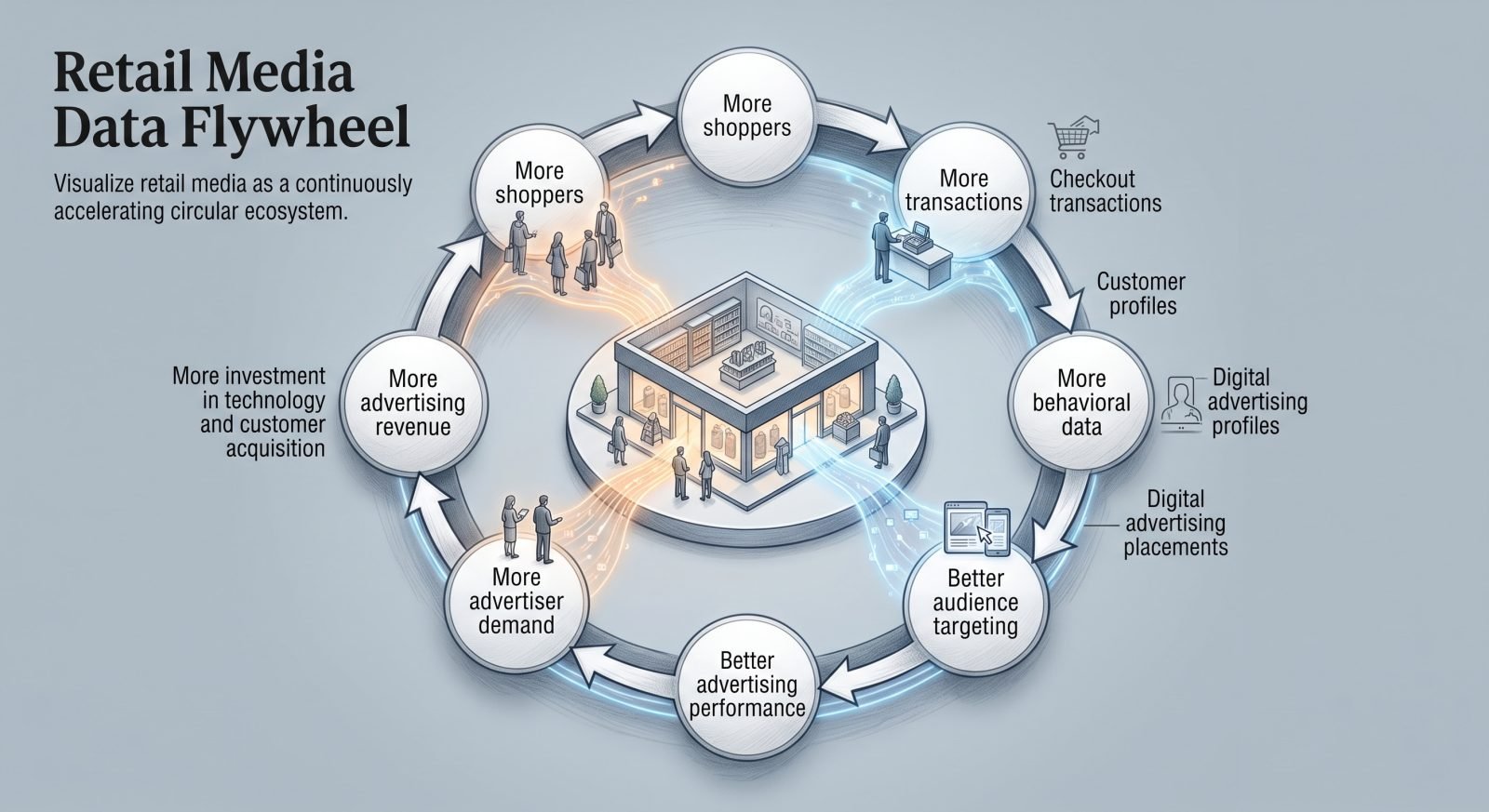
Retail Media Also Creates a Data Flywheel
The model becomes even more powerful as the retailer grows.
More shoppers
↓
More transactions
↓
More behavioral data
↓
Better audience targeting
↓
Better advertising performance
↓
More advertiser demand
↓
More advertising revenue
↓
More investment in technology and customer acquisition
↓
More shoppers
This creates a retail media flywheel.
Scale becomes an advantage not only in procurement and logistics, but also in advertising.
That is why smaller retailers face a difficult strategic question.
Can Smaller Retailers Compete?
Yes—but not by copying Amazon.
A regional grocery chain may never have Amazon's scale.
But it might have something Amazon cannot perfectly replicate:
local and category-specific customer intelligence.
A regional retailer could potentially build advertising around:
- local consumers
- regional brands
- grocery categories
- loyalty programs
- seasonal shopping
- local events
- store-level purchasing patterns
The competitive advantage may therefore shift from scale alone toward quality and specificity of data.
The Biggest Opportunity May Be Outside the Website
Early retail media focused heavily on sponsored product listings.
The next phase is much broader.
Retailers are expanding into:
Connected TV
Retailers can connect advertising exposure with shopping behavior.
In-store digital media
Screens, kiosks and digital signage can become advertising inventory.
Mobile applications
Retailer apps can provide highly contextual advertising opportunities.
Social commerce
Retail data can increasingly support advertising beyond the retailer's own properties.
Email and loyalty
Customer relationships can become targeted media channels.
Off-site advertising
Retailers can use first-party audiences across external publishers and platforms.
Amazon's retail media research notes that connected TV, in-store digital signage and AI-powered optimization are among the emerging opportunities for retail media networks.
The retailer is therefore building something much larger than a sponsored-search product.
It is building a commerce-powered media ecosystem.
But Retail Media Has a Serious Problem: Conflict of Interest
The economics are attractive.
The governance is complicated.
A retailer has multiple objectives:
- maximize sales
- protect customer experience
- maintain competitive pricing
- maximize advertising revenue
- protect relationships with suppliers
These objectives can conflict.
Imagine a retailer has two products:
- Product A has better customer value.
- Product B has a higher advertising bid.
Should Product B receive the top search position?
If the answer is always "the highest bidder," the retailer risks damaging customer trust.
This creates the central tension of retail media:
How much advertising can a retailer introduce before the shopping experience begins to feel like an advertising platform rather than a store?
The Margin Trap
Retail media can become so attractive that retailers may over-optimize for advertising revenue.
That would be a mistake.
A retailer should not measure retail media only by:
Advertising Revenue
It should measure:
**Incremental Advertising Revenue
- Incremental Product Sales
- − Incremental Technology Costs
- − Customer Experience Costs
- − Cannibalization
- − Promotional Costs**
The critical question is whether retail media creates incremental economic value.
If a brand pays for an advertisement that merely captures a sale that would have happened anyway, the retailer may be monetizing the transaction—but the advertiser may eventually challenge the economics.
That is why measurement quality matters.
Retail Media Is Becoming a B2B Business Inside a B2C Company
This is another major organizational change.
A retailer traditionally manages:
- merchandising
- stores
- supply chain
- eCommerce
- marketing
- customer service
A serious retail media operation additionally needs:
- media sales
- advertising operations
- data science
- audience management
- ad technology
- measurement
- analytics
- account management
- creative services
- compliance
- privacy governance
Retailers are effectively building a B2B advertising company inside a B2C retail organization.
Amazon's 2026 retail-media research similarly describes building an RMN as a business transformation rather than merely a technology project, requiring capabilities in technology, media sales and measurement.
What Retailers Should Measure
A sophisticated retail media strategy should go beyond advertising revenue.
Important metrics include:
MetricWhy It MattersAdvertising RevenueDirect monetizationAdvertising MarginProfitability of the media businessROASAdvertiser returnIncremental ROASTrue incremental impactConversion RateCommercial effectivenessCustomer Lifetime ValueLong-term customer economicsBasket SizeImpact on transaction valueRepeat Purchase RateRetention impactAd LoadCustomer experienceCannibalizationWhether ads replace organic demandIncremental SalesTrue commercial contributionCustomer TrustLong-term sustainability
The most important metric may ultimately be:
Incremental economic value created per customer interaction.
What Happens to Traditional Advertising?
Retail media does not necessarily replace Google, Meta, television or other advertising platforms.
Instead, it changes the advertising mix.
Brands increasingly want:
Awareness + Consideration + Conversion + Measurement
Retailers are particularly powerful in the conversion portion.
This creates an interesting possibility:
The retailer becomes both the distribution channel and the advertising channel.
That is strategically powerful because the retailer controls the point where advertising becomes commerce.
Retail Media and AI Could Become Even More Powerful
The next major evolution is the combination of retail media and artificial intelligence.
Imagine an AI shopping agent helping a consumer purchase groceries.
The agent knows:
- previous purchases
- budget
- preferences
- dietary requirements
- household size
- current promotions
Now imagine brands competing for recommendation visibility.
The advertising model could move from:
"Show this banner to the consumer."
to:
"Recommend this product when the consumer's intent matches the product."
That is a fundamental change.
Retail advertising could move from attention-based advertising toward intent-based recommendation economics.
This could become one of the most important developments in commerce over the next decade.
The Strategic Risk: Retailers Could Become Gatekeepers
There is also a downside.
If a small number of retailers control:
- product discovery
- search
- customer data
- advertising
- payments
- fulfillment
- loyalty
- AI recommendations
they can become powerful gatekeepers between brands and consumers.
That creates questions around:
- advertising transparency
- competition
- data ownership
- ranking algorithms
- privacy
- sponsored recommendations
- marketplace fairness
The more valuable retail media becomes, the more regulatory and competitive scrutiny it is likely to attract.
The Future of Retail Media
The retail media industry is moving through several stages.
Stage 1: Sponsored Products
Brands pay for visibility on retailer websites.
Stage 2: Closed-Loop Measurement
Retailers connect advertising exposure to actual purchases.
Stage 3: Omnichannel Media
Advertising expands across websites, apps, stores, email, social and connected TV.
Stage 4: Retail Data Activation
Retailer audiences are activated across external advertising ecosystems.
Stage 5: AI-Powered Advertising
Algorithms dynamically optimize audiences, creative, placement and bidding.
Stage 6: Agentic Commerce
AI shopping agents begin influencing product discovery and purchase decisions.
At that point, retailers may not simply compete for human attention.
They may compete for AI recommendation preference.
That could fundamentally change digital commerce.
The New Retail Question
For years, retailers asked:
"How can we sell more products?"
The more important question now may be:
"How many different ways can we monetize the customer relationship without damaging it?"
Retail media provides one answer.
The retailer sells the product.
The retailer sells marketplace access.
The retailer sells memberships.
The retailer may provide financial services.
And increasingly, the retailer sells advertising access to the customer.
The store is becoming an economic platform.
Conclusion: Retailers Are Building Businesses on Top of Retail
Retail media networks represent more than another advertising trend.
They represent a structural change in retail economics.
The physical store, website, mobile application, loyalty program, marketplace and customer database are no longer separate assets.
Together, they form a monetizable ecosystem.
The most successful retailers of the next decade may therefore not be the companies with the highest product margins alone.
They may be the companies capable of extracting the greatest total economic value from every customer relationship.
That is the real significance of retail media.
The future retailer may not make its best margins from the products sitting on the shelf. It may make them from the economic ecosystem built around the shopper standing in front of that shelf.
#RetailMedia #Retail #eCommerce #DigitalCommerce #RetailStrategy #RetailTech #AmazonAds #WalmartConnect #RetailAnalytics #ShopperData #RetailEconomics #Advertising #Commerce
Editorial research notes
The article's central thesis is strongly supported by the current market: Amazon's 2025 advertising-services revenue reached $68.635 billion, while Walmart reported 37% global advertising growth and 41% U.S. Walmart Connect growth in FY2026. [Reference]
Target's current description of Roundel also illustrates the evolution from onsite sponsored placements toward a broader media ecosystem spanning Target properties and external publishers. [Reference]
And this is becoming a competitive advertising category, not merely an Amazon phenomenon: 2026 marketer research shows Amazon and Walmart Connect remain the most-used RMNs, with Target's Roundel also among the leading networks. [Reference]


Comments
No approved comments yet.