
The First Agent-Assisted Holiday: How AI Shopping Agents Will Shape Retail’s $1 Trillion Season
By Pritam Khedekar · Oct 18, 2026
The Holiday Season Gets a New Front Door
Every holiday season has a defining shift. There was the year mobile overtook desktop, the year buy-online-pickup-in-store became mainstream, the pandemic year when everything moved online at once.
2026 has its own: this is the first holiday season where AI agents operate at real scale.
In my earlier piece on agentic commerce, I argued that AI agents are quietly replacing the search bar as the starting point for shopping. The holiday season is the stress test for that idea. It’s the highest-volume, most time-pressured, most price-sensitive stretch of the retail year, which makes it exactly where convenience technology either proves itself or breaks.
The early numbers suggest it’s going to prove itself, though not in the way most headlines imply.

The Scale of the Season
Start with the backdrop. NRF expects 2026 holiday sales to grow 4.2% to $1.013 trillion. Online, Adobe projects sales in the last two months of the year will reach $275.1 billion, a 6.7% increase over last year.
Now layer in AI. Adobe projects AI traffic to U.S. retail sites will rise 130% year over year this holiday season. Salesforce goes further, predicting that 20% of all holiday eCommerce traffic in 2026 will originate from AI chat agents.
The foundation for this was laid last year. During Cyber Week 2025, one in five orders involved an agent, roughly $70 billion in GMV, according to Salesforce. And consumer habits have shifted fast since then: reliance on AI assistants as the first stop in the shopping journey grew 200% in a single year, from May 2025 to May 2026.
Read the Fine Print: Not All Agent Traffic Is a Shopper
That 20% figure is the kind of number that ends up on conference slides. It deserves a closer look.
Salesforce’s own definition says that agent traffic will be a mix of consumer-facing bots handling live queries, autonomous agents executing backend tasks, and competitor scrapers fueling algorithmic price-matching.
That last category matters a lot. Some of the “AI traffic” hitting retail sites this season won’t be shoppers at all. It will be competitors’ bots checking your prices every few minutes so their algorithms can undercut you.
This changes how retailers should read their dashboards. A spike in agent traffic is not automatically a spike in demand. Some of it is demand. Some of it is surveillance.
Traffic Is Up. Orders Aren’t Keeping Pace.
There’s an even more important signal hiding in the data. According to the Salesforce Shopping Index, global digital traffic grew 18% in Q2, but order volume rose just 1%.
That gap is the clearest picture of what agents are doing right now. They are dramatically increasing the amount of browsing, comparing, and checking that happens, without proportionally increasing purchases.
Think about what an agent does when a shopper asks, “Find me a good espresso machine under $300 for my dad.” It might visit 20 product pages across 10 retailers in seconds, compare specs, check reviews, and look for coupons. That’s 20 visits for what will become, at most, one order.
For retailers, this has real consequences:
- Conversion rate metrics get distorted. More visits with similar order volume makes conversion look worse even when nothing is wrong.
- Infrastructure costs rise. Serving all that bot traffic during peak season costs money, without a matching rise in revenue.
- The shortlist becomes everything. If an agent visits 20 pages but recommends three, being in the three is all that matters.
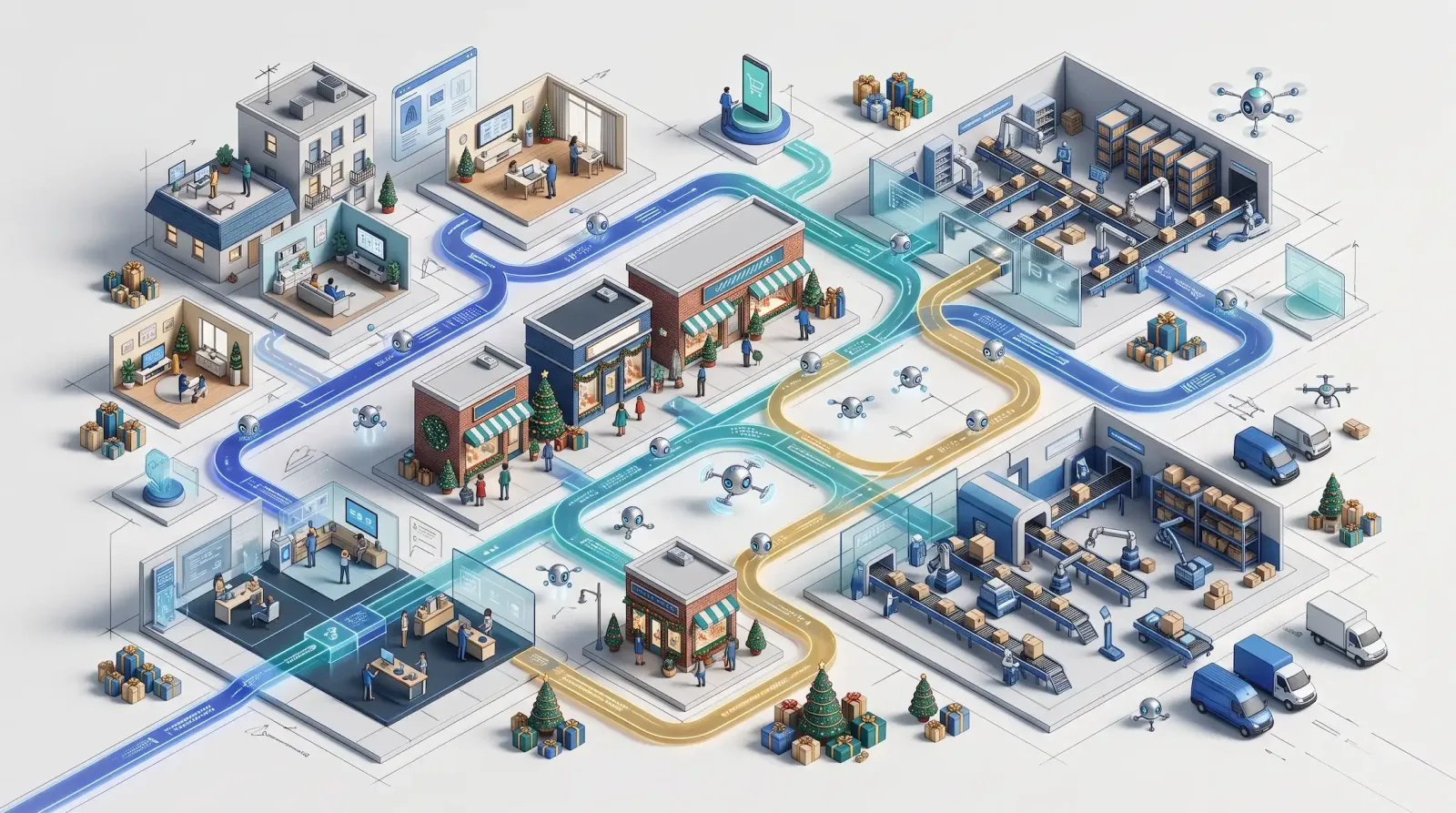
Where Agents Actually Earn Their Place
So what are shoppers using agents for this holiday? The answer is the early, tedious parts of the journey.
Salesforce research shows that general AI assistants earn their place early: gift list generation, promo code hunting, and product comparisons.
That fits the broader evidence. Consumers want help, but not autopilot. Worldpay’s 2026 research found that among consumers open to AI shopping, 59% still want to approve every purchase individually. And as I noted in my earlier piece, OpenAI pulled back its in-chat Instant Checkout earlier this year. For now, agents recommend and humans buy.
The holiday season actually strengthens this pattern. Gift buying is emotional and personal. Shoppers are happy to let an agent narrow 500 options to five. They are far less likely to let it pick the final gift for their mother.
The Store Isn’t Losing. It’s Being Fed.
One of the most interesting findings this season contradicts the “AI replaces stores” narrative.
Salesforce reports that 77% of consumers prefer physical stores for holiday shopping, ahead of online marketplaces at 69%. And it predicts that 38% of holiday retail dollars will come from “hybrid sales,” combining digital research, AI, or mobile activity with a physical-store purchase.
This is where I think the industry conversation often goes wrong. Agents aren’t only an eCommerce story. A shopper might ask an agent which store nearby has a specific toy in stock, then drive there to buy it. The agent did the discovery. The store got the sale.
That means store inventory accuracy, real-time availability data, and reliable pickup systems are now part of how agents decide what to recommend. From my experience working with retail point-of-sale and store systems, I’d argue this is one of the most underrated priorities for this season. If a store’s data says an item is in stock when it isn’t, an agent will send a customer there, the customer will leave empty-handed, and both the agent and the shopper will learn to trust that retailer less.
The Business Impact: Who Wins This Holiday
Winners
- Retailers with their own branded agents. Retailers using branded AI shopper agents saw 59% higher holiday sales growth in 2025: 6.2% for brands with shopper agents versus 3.9% for those without. A branded agent lets a retailer keep the conversation on its own turf instead of handing it to a third-party assistant.
- Retailers with clean, structured product data. Agents compare facts. The brands with complete attributes, accurate pricing, and clear shipping and return information get shortlisted.
- Omnichannel operators with accurate store inventory. The hybrid shopper rewards retailers whose digital and physical data agree.
Losers
- Retailers relying on vague product listings. If an agent can’t confirm compatibility, size, or delivery date, it moves on.
- Brands depending on promotional confusion. Agents are relentless coupon hunters and price comparers. Holiday pricing tactics that rely on shoppers not checking elsewhere will weaken.
- Retailers who misread their analytics. Treating scraper traffic as demand can lead to bad inventory and marketing decisions at the worst possible time of year.

The Financial Perspective: What Agents Do to Holiday Margins
Price transparency compresses margin. Agents compare total landed cost, including shipping, in seconds. That makes it harder to hold price on commoditized items during the most promotional weeks of the year.
Free shipping gets more expensive, and more important. Across every income level, shoppers ranked free shipping as the most important factor in choosing where to buy this holiday. Salesforce forecasts retailers will spend an additional $3 billion globally subsidizing free shipping, a 7% increase over 2025, as logistics costs rise. Agents surface these differences instantly, so a retailer charging for shipping when a competitor doesn’t may simply never make the shortlist.
Customer acquisition costs shift. Shoppers arriving from an agent recommendation often have high intent, which can lower acquisition costs per order. But the cost of being visible moves toward data quality, protocol integrations, and branded agent development.
Operating costs rise during peak. Bot traffic consumes server capacity during the most expensive weeks of the year. Retailers need to plan infrastructure for the agents as well as the humans.
Holiday loyalty becomes harder to earn. If a shopper’s loyalty belongs to their agent, a great holiday experience might not translate into a repeat customer in January. That raises the value of loyalty programs that agents can actually read and apply.
What Retailers Should Do Before Black Friday
There’s still time to act. With roughly a month before peak season, here’s where I’d focus:
1. Audit your top 100 holiday products. Make sure every attribute, price, shipping time, and return policy is complete and consistent across your site and feeds. These are the products agents will be asked about most.
2. Separate agent traffic from human traffic in your analytics. Track AI-referred visits, scraper traffic, and human sessions separately. Otherwise your conversion data will mislead you during the most important weeks of the year.
3. Lock down store inventory accuracy. For hybrid shoppers, availability data is your marketing. A wrong “in stock” signal costs more than one sale.
4. Make holiday offers machine-readable. Promotions, bundles, and loyalty pricing should be clearly structured so agents can find and apply them, not buried in images or pop-ups.
5. Plan for peak bot load. Work with infrastructure teams to make sure sites can handle elevated agent traffic without slowing down for human shoppers. Uptime during Black Friday is revenue.
6. Consider a branded agent, even a simple one. A focused gift-finder or product advisor on your own site keeps the conversation in your hands.
Future Outlook: What This Holiday Will Teach Us
When the season ends, I expect three lessons to stand out.
First, agents will prove they own discovery. The gap between traffic and orders will make it clear that agents shape the shortlist even when humans make the final purchase.
Second, the line between online and in-store will blur further. Hybrid sales will show that AI often sends shoppers to stores rather than away from them.
Third, measurement will become the next battleground. Retailers will realize their analytics weren’t built for a world where a meaningful share of visitors aren’t human. Expect 2027 to bring a wave of investment in agent-aware analytics.
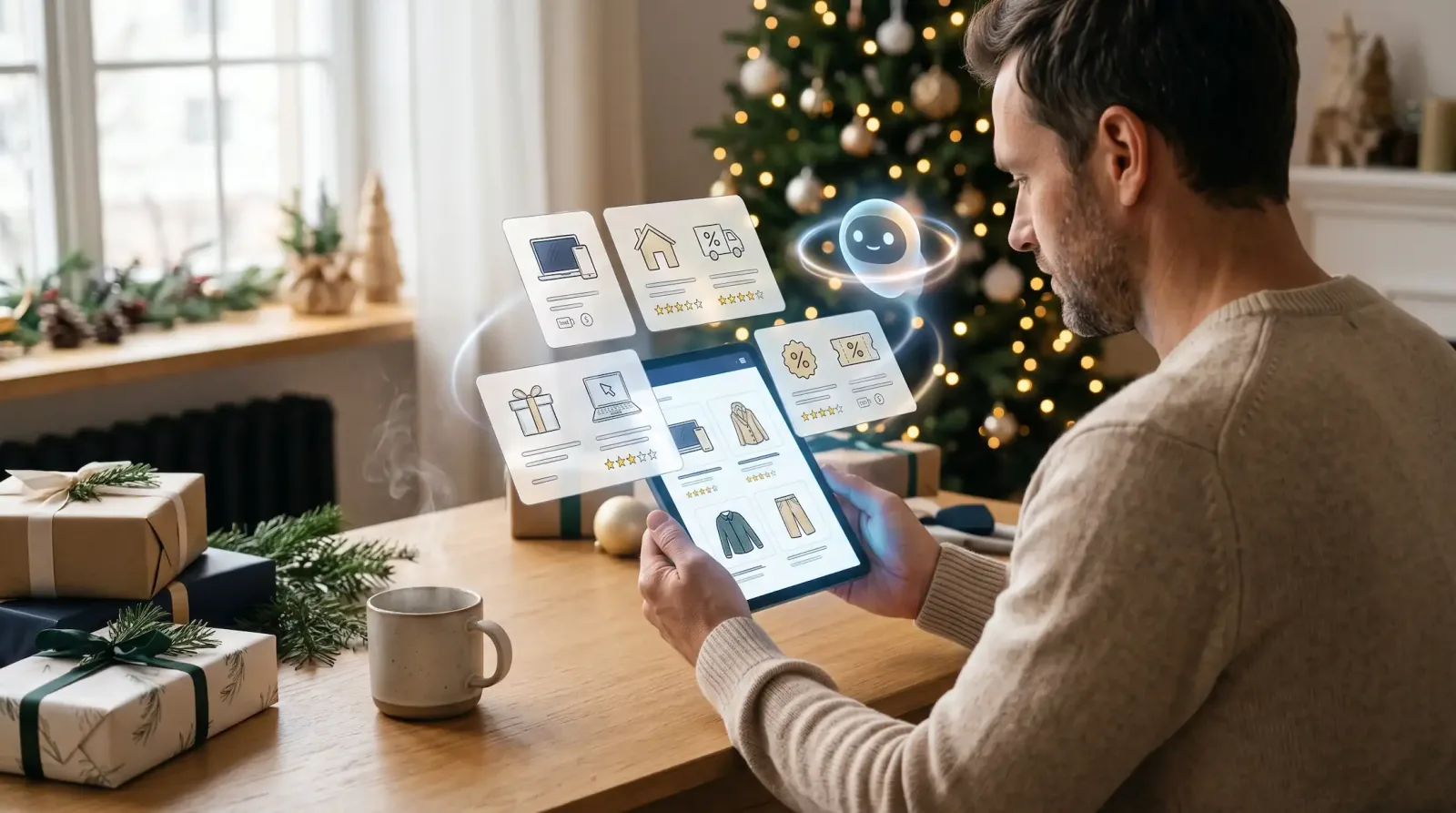
The Agent Builds the List. The Retailer Still Has to Earn the Sale.
The headlines will say this was the year AI took over holiday shopping. The reality will be more nuanced and, for prepared retailers, more useful.
Agents won’t be buying most gifts this year. But they will be deciding which products shoppers see, which retailers make the shortlist, and which stores get the visit. That’s enormous influence, exercised mostly before anyone clicks “buy.”
The retailers who win this season won’t be the ones with the most impressive AI announcements. They’ll be the ones whose data is accurate enough for an agent to trust, whose prices and shipping are clear enough to compare, and whose stores actually have what the agent promised.
This is the first agent-assisted holiday. It won’t be the last. The lessons learned in the next ten weeks will shape retail strategy for years.


Comments
No approved comments yet.